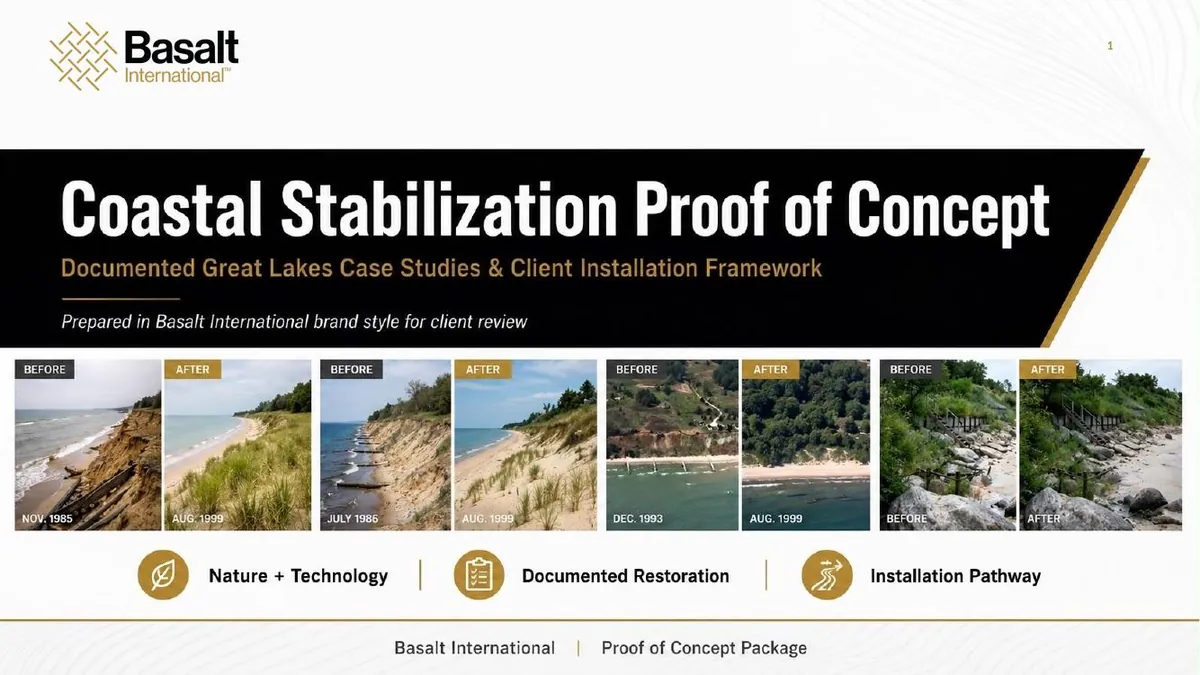
Coastal technology
Coastal Accretion Engineering — restoring shorelines naturally
Beach Recovery builds on decades of field-proven coastal engineering. The foundational methods have evolved over more than forty years and have been implemented in nearly thirty locations worldwide. One long-standing example in Saudi Arabia has continued to perform for over two decades.


Independent third-party validation
The system is supported by over forty years of independent research, case studies and environmental monitoring conducted by universities, coastal engineers and government-sponsored analysts.
Performance and accretion
Western Michigan University documented significant sand accretion and beach volume gain following installation, with no negative impact recorded on adjacent coastal zones.
Sand migration
Monitoring by George F. Young, Inc. reported a net gain of over 10,000 cubic yards of beach material in targeted sections.
Aquatic environment health
Independent biological assessments found stable populations of native marine species and no adverse impact on benthic habitats.
Water quality
Evaluations identified indicator species such as amphioxus, consistent with good water quality in installation areas.
Structural durability
Engineering analysis from the University of Patras, Greece confirmed long-term stability under extreme wave and climate conditions, with minimal maintenance required.
A soft-engineering answer to destructive wave energy
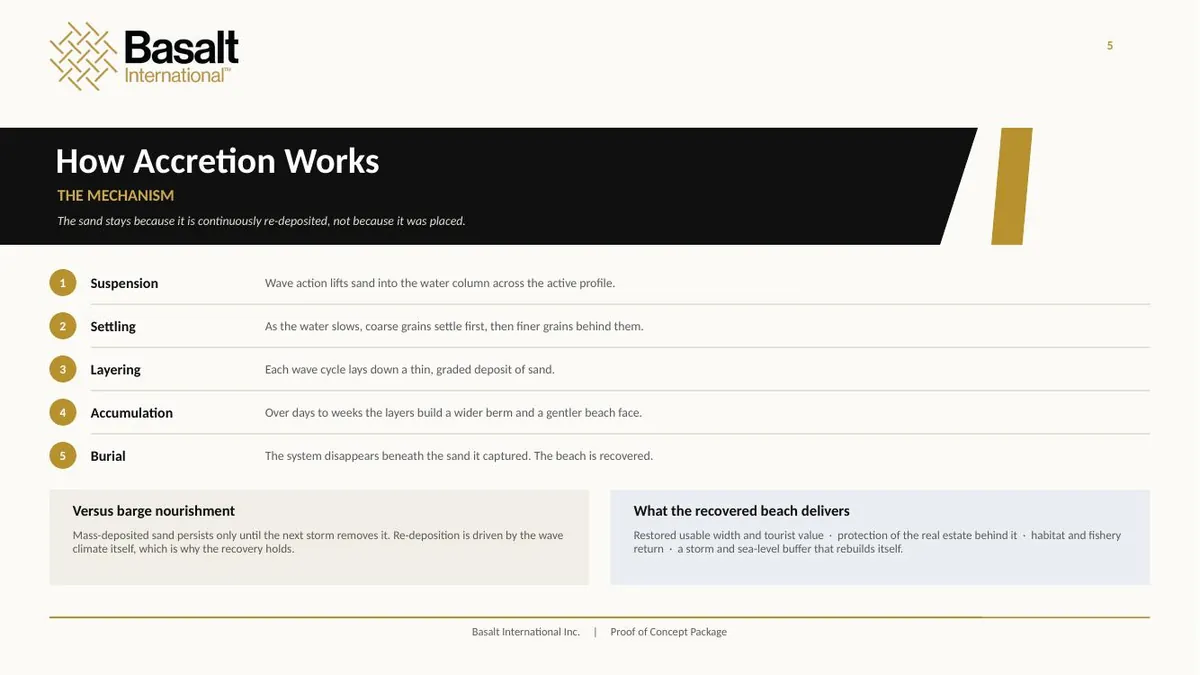
Coastal Accretion Technology absorbs and dissipates hydrodynamic energy. It works as a permeable, flow-through system: natural current pathways are kept open while induced de-energizing vortices slow the water. As flow decelerates, suspended sediment precipitates and accumulates, and seabed accretion begins the restoration phase.
Once erosion is under control, the system is folded into a five-phase beach restoration protocol focused on ecological succession, shoreline stability and long-term coastal resilience. Modules are engineered for minimal environmental impact, passive safety for swimmers and zero-maintenance operation after deployment.


Before and after, site three


Scalable impact
One installation can restore a long stretch of coastline rather than a single frontage.
Eco-compatible
Natural sediment flows are preserved and habitat health is supported rather than interrupted.
Cost-efficient
Reduces or removes the need for repeated beach nourishment.
Scientifically grounded
Supports third-party monitoring of shoreline change, habitat growth and water quality.
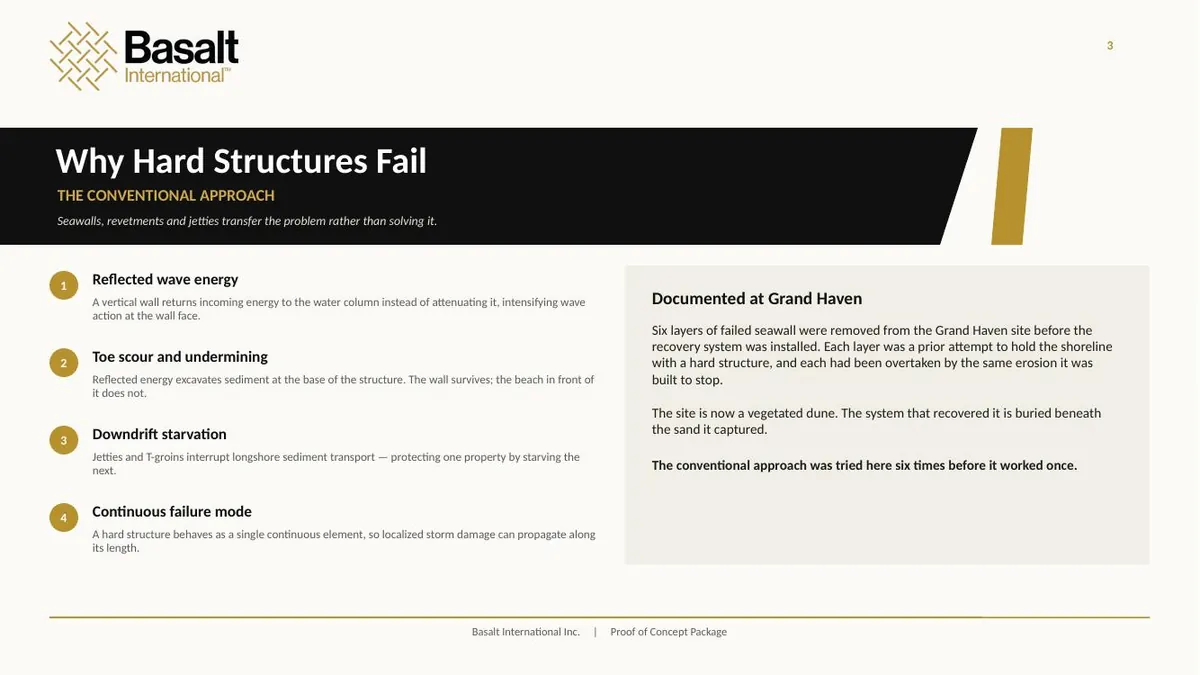
Why hard structures fail
Seawalls, revetments and jetties transfer the problem rather than solving it.
Reflected wave energy
A vertical wall returns incoming energy to the water column instead of attenuating it, intensifying wave action at the wall face.
Toe scour and undermining
Reflected energy excavates sediment at the base of the structure. The wall survives; the beach in front of it does not.
Downdrift starvation
Jetties and T-groins interrupt longshore sediment transport — protecting one property by starving the next.
Continuous failure mode
A hard structure behaves as a single continuous element, so localized storm damage can propagate along its length.
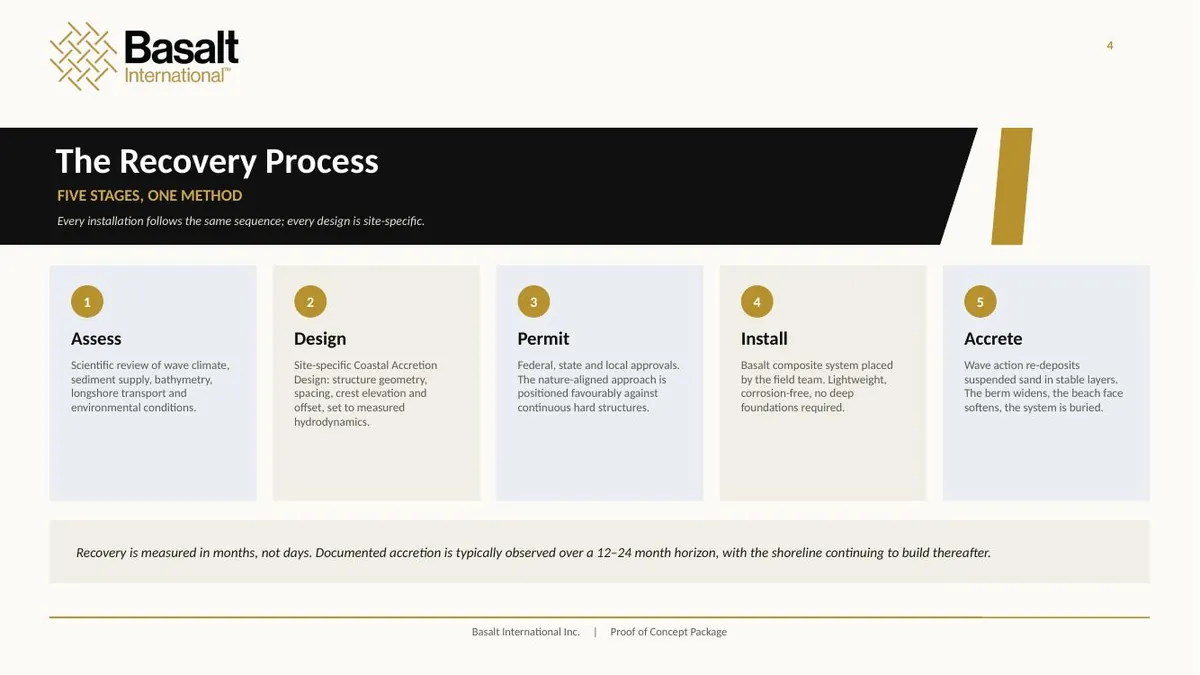
The recovery process — five stages, one method
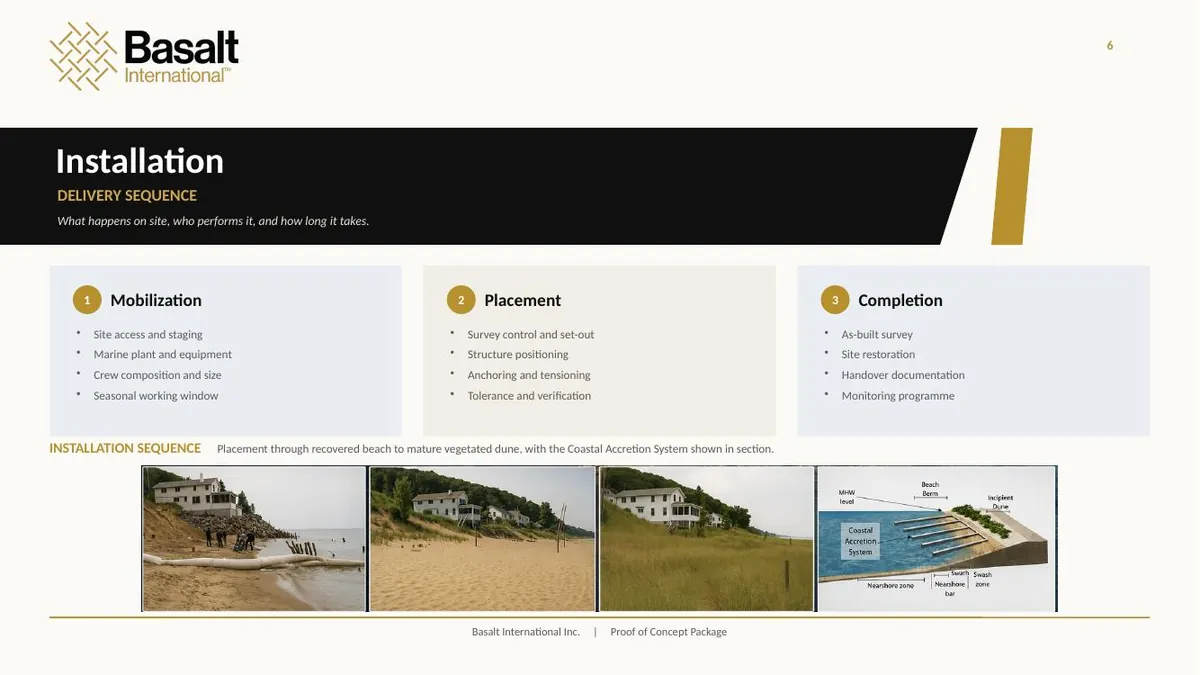
Every installation follows the same sequence; every design is site-specific. Recovery is measured in months, not days: documented accretion is typically observed over a twelve to twenty-four month horizon, with the shoreline continuing to build thereafter.
1. Assess
Scientific review of wave climate, sediment supply, bathymetry, longshore transport and environmental conditions.
2. Design
Site-specific coastal accretion design: structure geometry, spacing, crest elevation and offset, set to measured hydrodynamics.
3. Permit
Federal, state and local approvals. The nature-aligned approach is positioned favourably against continuous hard structures.
4. Install
Basalt composite system placed by the field team. Lightweight, corrosion-free, no deep foundations required.
5. Accrete
Wave action re-deposits suspended sand in stable layers. The berm widens, the beach face softens, the system is buried.
Permitting pathway
Approvals are sequenced, scoped and initiated before mobilization.
Federal
U.S. Army Corps of Engineers authorization under Section 404 of the Clean Water Act and Section 10 of the Rivers and Harbors Act for work in navigable waters.
State
State environmental and coastal-zone authorization, including submerged lands consent where the structure sits below the ordinary high-water mark.
Local
Municipal and county approvals, shoreline setback review, and any applicable coastal construction control line permitting.
Environmental
Habitat, protected-species and water-quality review. The nature-aligned approach is generally received more favourably than continuous hard structures.